


Many people visiting me in my office have confidently remarked:
“I’ll bet you have plenty of healthy light in your office—it’s got big windows, bright Southern California views… you’re covered.”
And my response? “I’ll take that bet.”
The Light You Think You Have
We do a lot of work here at BIOS to understand how blue sky light moves through the built environment – and that’s because of the well-known health and performance benefits that daylight has to our minds and bodies.
On a clear day, blue-sky light is intense and everywhere. Step outside and you can measure tens of thousands of melanopic lux or m-EDI, the measure of healthy blue sky light —more than enough to energize your body, lift your mood, and set your circadian rhythm. So, it’s easy to assume that if you bring that light indoors through a window, you’re getting the same benefit.
But that daylighting assumption ignores something important:
Blue-sky light doesn’t simply “arrive” indoors—it goes on an odyssey worthy of the name. And like Odysseus’ men in Homer’s epic poem, that initially intense illumination dwindles along the way to your brain – despite never being far from a window.
The First Filters: Sky and Weather
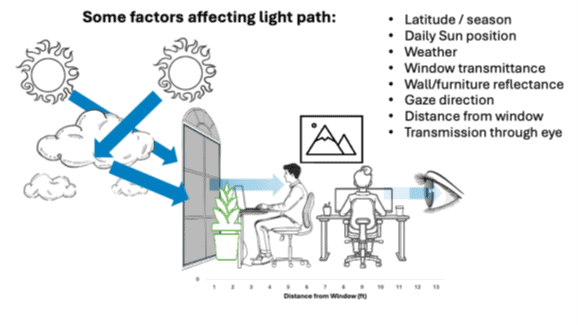
That epic journey begins in the sky itself. The position of the sun, time of day, and season all influence how much useful light is available. Add in weather or even just clouds and the available melanopic signal can drop dramatically.
A bright morning might deliver 60,000 melanopic lux outdoors. By afternoon, or under overcast conditions, that can fall to a tenth of that value. Still plenty, you might think. And you’d be right—outside.
Windows will Cost You
Modern buildings are designed for energy efficiency, and windows are a big part of that. But coatings and tinting that reduce heat and glare also reduce transmission of blue-sky wavelengths. A clear window might have a visible light transmittance (VLT) around 70%. Many commercial windows with energy-code mandated tinting (ASHRAE 90.1; Title 24) can drop to 40%, even 15% in upper floors. So now, before the light even enters the room, a significant amount is gone. You might not notice the drop even at 15% transmittance. In fact, it might even seem nicer because glare would be significantly reduced. But, since the blue sky light is just a small proportion of the total light coming through the window, the loss has bigger impact on your overall healthy light exposure.
Read: Boosting Healthy Blue Sky in a Tinted Window World
Window Distance: The Quiet Multiplier
Once inside, light intensity decays quickly with distance as described by the inverse square law. At the window, levels may still be high. But move just a few feet away, and the drop is substantial. By six feet or more—a typical desk position—the available light can fall dramatically. Move deeper into the space, and it continues to fade to a general low level boosted where needed by electric lighting.
So, the effect of sun position, weather, and window distance isn’t linear. It’s compounding and we’re not done yet.
Read: Daylighting, Weather, and Wuthering Heights
Where You Look Matters for Healthy Blue Sky Light Exposure
Then there’s something most people never consider: your gaze direction. If you’re looking out the window, you’re capturing more of that light. But most of us spend our day turned 90 degrees to look at screens, walls, or desks. In doing so, we can lose a large portion of the available melanopic signal—often by two-thirds or more regardless of distance from the window. So, even in a bright room, the light that actually reaches your eyes may be far lower than one might expect. Monitors – even large ones – unfortunately do not typically provide an adequate boost in melanopic light to fix daytime deficiencies (Dianagri et al. 2025; Unpublished data).
Read: A Window on Melanopic Light: How View Direction Dramatically Impacts Natural Light Exposure
The Final Filter: Your Eyes
And then comes the last step in the journey: your own eye. As we age, the lens naturally yellows and absorbs more short-wavelength (blue) light. Research shows that the blue sky light at 480nm wavelength decreases by 72% from age 10 to age 80 (Kessel et al. 2010; Turner & Mainster 2008). So, although a thirty-something office worker may transmit around 65% of that light to the retina – by age 60, that number can drop to around 35%. Same room. Same seat. Completely different biological impact.
Running the Numbers on Blue Sky Light Exposure
Let’s consider some common room lighting scenarios to see how melanopic light changes on its path to the occupant.
A perfect world for healthy office lighting
To maximize light to each individual, you would preferably have an always sunny, always easterly facing view with your desk facing the window 3ft away or less. Oh, and always have 10-year-old eyes. The numbers for a 30-year-old worker in somewhat ideal conditions might look like this:
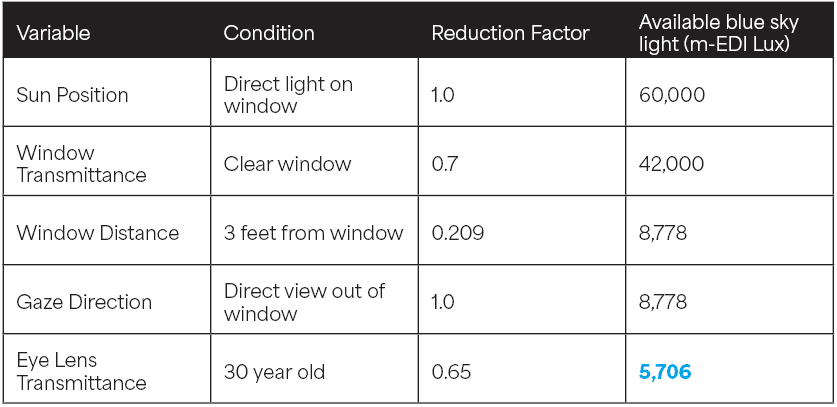
So, in the more ideal condition, the occupant would have far more than the suggested 250 m-EDI threshold for daytime melanopic light exposure. Of course, excessive heat and glare may be an issue requiring dimming, louvering or otherwise blocking the incoming light.
The Real World is More Complicated
The sun moves, weather changes, room occupants are often a little further from windows and busy looking at screens. These combined effects result in very significant changes in light exposure. Let’s look at the interplay of these factors starting with our 60,000 m-EDI Lux blue sky day.
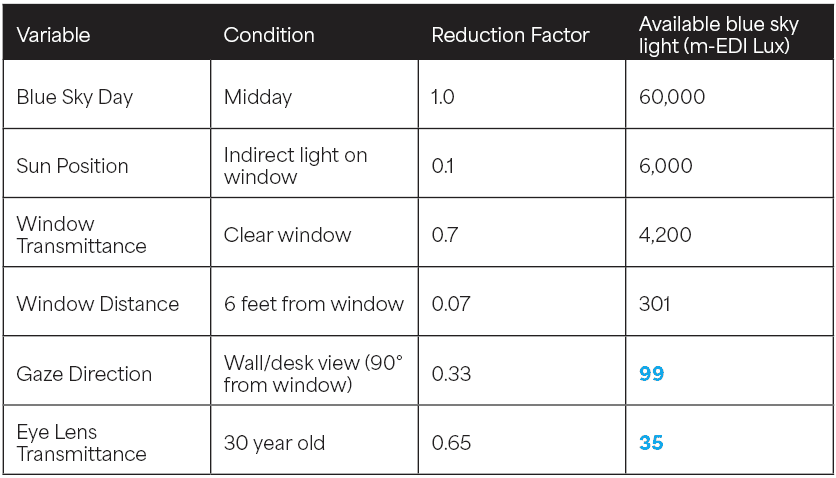
Despite being a bright office with a window view possible, the occupant at their desk is only receiving 99 m-EDI at the eye and 35 m-EDI at the retina. Quite a loss given our 60,000 lux start. And bright standard ceiling tile electric lighting typically adds only another 70 or so and monitors perhaps another 10-20 m-EDI.
The Real, Real World Example of My Office Lighting

The author’s world: 60-year old office worker with periodic weather, morning sun, a large tinted east window, desk/wall view, 6ft away.
Now, I’m a betting person, so let’s do the math for my office lighting. When you combine all these factors—sun position, weather, window transmission, distance, gaze direction, and age—the results can be surprising.
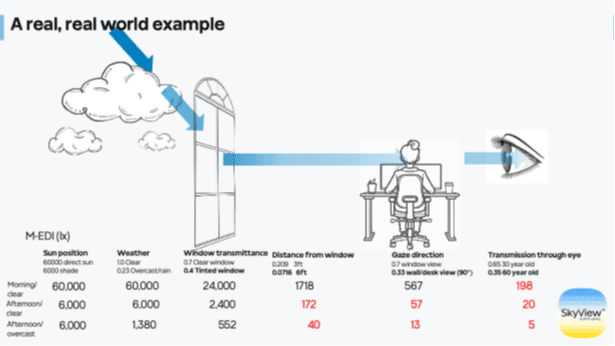
From morning sun to afternoon overcast conditions, my final available healthy blue sky light levels are never above the 250 m-EDI wellness threshold. All factors combined, I’m receiving about 198 m-EDI in the morning, twenty for clear afternoon light, and for overcast? A mere five.
So, a scenario that starts with abundant outdoor light can quickly diminish to levels well below what’s needed for healthy circadian stimulation by the time it reaches the retina. Especially in the afternoon. Especially on cloudy days. Especially for older occupants.
I wish this was an unusual case but extensive field measurements show that many office (Ticleanu et al. 2025), classroom (Ezpeleta et al. 2021) and elder care spaces (Kolberg et al. 2022; Li et al. 2026) are well below the threshold. Add other blue light absorbing features like natural woods, plants, or earthtone colors (common in biophilic design) and you have a really nice looking but melanopically dark and unhealthy space.
What Melanopic Light’s Arduous Journey Means for Design
Designers have done an incredible job bringing daylight into buildings. But even with best practices and sophisticated computer modeling to maximize windows, glazing, views, open layouts—the math of individuals in the space tells a different story. There is simply a long and lossy path for healthy light between the blue sky and the human eye.
That’s why the industry is beginning to rethink lighting—not just in illumination as a visual tool, but as a biological complement for daylighting. Standards like IES RP-46-25 are starting to recognize that delivering adequate melanopic light indoors to every occupant often requires more than daylight and standard electric lighting support. Advanced light modelling software that includes melanopic light estimates in the layout are becoming mainstream (Sanchez-Cano et al. 2024); however, without a practical, melanopic-rich general lighting source beyond windows the best they can provide is healthy light some of the time in some of the daylit spaces (Safranek et al. 2023; Ticleanu et al. 2025).
So… Would You Still Bet on Daylighting?
At first glance, it’s easy to assume your office gets plenty of good light, and if you need boost, your standard lighting and monitors will be adequate. But once you follow the full epic journey—from sky to glass to room to eye—it becomes clear how much is lost along the way. Without effective, healthy blue sky lighting from SkyViewTM in my office, I would be in real trouble.
So yes—when someone says, “I’ll bet this daylit office light is good enough,” I’ll take that bet.
References
Dianagri AT, Gocer O, Hu W. Integrating monitors into circadian lighting strategies for offices. Journal of Building Engineering. 2025 Sep 15;110:113051.
Ezpeleta S, Orduna-Hospital E, Solana T, Aporta J, Pinilla I, Sánchez-Cano A. Analysis of photopic and melanopic lighting in teaching environments. Buildings. 2021 Sep 27;11(10):439.
Illuminating Engineering Society. ANSI/IES RP-46-25: Recommended Practice: Supporting the Physiological and Behavioral Effects of Lighting in Interior Daytime Environments. 2025.
Kessel L, Lundeman JH, Herbst K, Andersen TV, Larsen M. Age-related changes in the transmission properties of the human lens and their relevance to circadian entrainment. Journal of Cataract & Refractive Surgery. 2010 Feb 1;36(2):308-12.
Kolberg E, Pallesen S, Hjetland GJ, Nordhus IH, Thun E, Flo-Groeneboom E. Insufficient melanopic equivalent daylight illuminance in nursing home dementia units across seasons and gaze directions. Lighting Research & Technology. 2022 Apr;54(2):163-77.
Li J, Wang T, Shao R, Yu C, Hao L, Wu Y. Quantitative Study of Indoor Light and Sleep Health in Elderly. HERD: Health Environments Research & Design Journal. 2026 19375867261426378.
Safranek S, Collier J, Baker J, Jacobsen J, Wilkerson A. Lighting for Health and Wellness Recommendations in Offices: A Circadian Lighting Pilot Project in Chicago, IL. Pacific Northwest National Laboratory (PNNL), Richland, WA (United States); Schuler Shook, Chicago, IL (United States); 2023 Jan 1.
Sanchez-Cano A, Orduna-Hospital E, Aporta J. Photopic and Melanopic Analysis of Daylight Through Glazing in Indoor Environments. Buildings. 2024 Oct 17;14(10):3291.
Ticleanu C, Flores-Villa L, Littlefair P, Howlett G. Assessing melanopic equivalent daylight illuminance in office spaces using a simplified approach for predominantly cloudy climates. Lighting Research & Technology. 2025 Feb 24:14771535251317740.
Turner PL, Mainster MA. Circadian photoreception: ageing and the eye’s important role in systemic health. British Journal of Ophthalmology. 2008 Nov 1;92(11):1439-44.