

How much useful light reach student’s eyes and not just their desks?
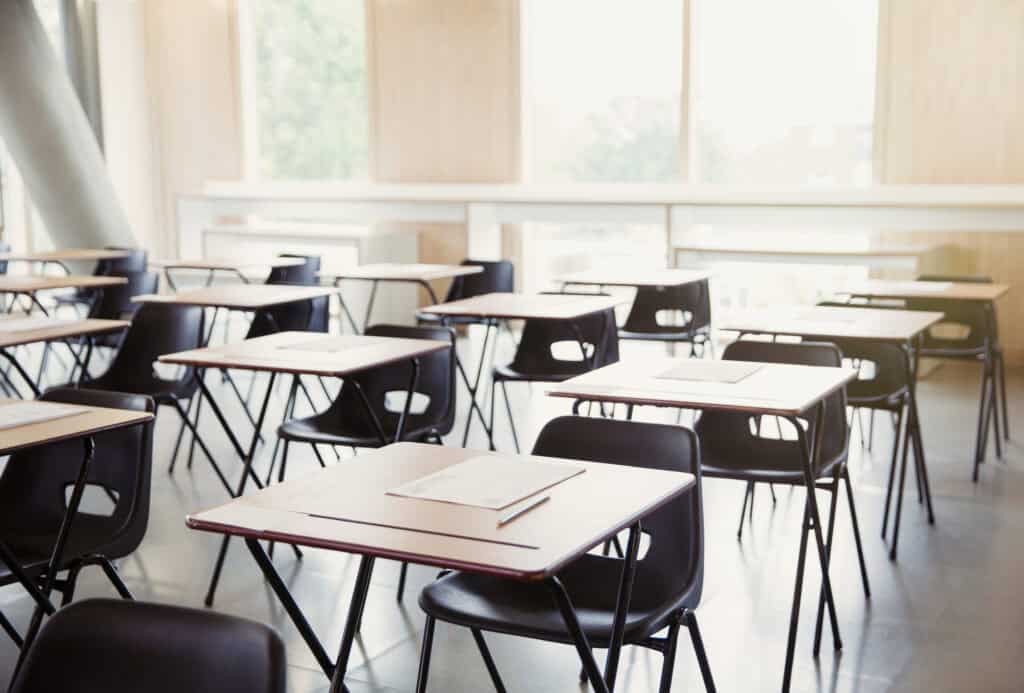
The most important question in classroom lighting isn’t simply how much light is on the desk, but how much biologically useful blue-sky light reaches the eyes in the vertical plane at the level of seated students.
Traditional classroom lighting is often designed around task plane (horizontal) illuminance. That remains important for reading, writing, and other visual tasks. But light entering the eyes also influences circadian timing, alertness, and other nonvisual responses.
The biomedical research community and the Illuminating Engineering Society both recommend evaluating biologically effective light at the plane of the observer’s eye rather than relying only on horizontal measurements. The current consensus recommendation for healthy, day-active adults is a minimum of 250 melanopic EDI lux at the eye during daytime (Brown et al. 2022; ANSI/IES RP-46-25).
A a standard classroom luminaire can deliver plenty of light on a desk while delivering considerably less biologically effective light toward students’ eyes. On average, only about half of the downward light makes it to the eye on the vertical plane. Given that standard fixtures already do not provide adequate blue-sky wavelengths of light, and half of that is lost to the eyes due to the downward direction of the light, many classrooms provide students less than 50% of the healthy light needed (see review in: Soler & Long 2026).
Design takeaway: Evaluate both horizontal light for visual tasks and vertical, eye-level light for the people occupying the room.

Can students see comfortably without glare and visual distraction?
More light isn’t necessarily better if it creates glare, reflections, or excessive contrast during classroom activities. Classrooms are dynamic and visually demanding environments. Students move their gaze among books, worksheets, teachers, whiteboards, displays, and computer screens. Where students sit in relation to windows, and the teacher focus can create significant differences in visibility and glare.
The Illuminating Engineering Society’s recommended practice for educational facilities emphasizes that classroom lighting should provide a comfortable environment, and that light distribution, glare, and shadows are important considerations alongside target illuminance (ANSI/IES 2026).
This becomes even more important as classrooms increasingly rely on digital displays. Recent classroom research found that low ambient illumination and high luminance contrast between learning media and surrounding surfaces can contribute to visual fatigue (Vidiyanti et al. 2025).
Design takeaway: Look at the entire visual environment including the key learning media and their position in relation to windows and student viewing angles. Control glare from both luminaires and windows, manage reflections on screens, and create comfortable luminance relationships throughout the room.

How should classroom lighting work with daylighting?
Daylight should be treated as part of the lighting system, but classrooms also need electric lighting that can deliver a consistent daytime environment when daylight is limited.
Windows can provide high levels of light, views to the outdoors, and a changing connection to time and weather. But daylight is highly variable. It changes with viewing orientation, season, weather, window size, glazing, shades, and a student’s distance from the window. The latest ANSI/IES RP-3-26 specifically expands guidance for educational facilities around daylighting and controls (ANSI/IES 2026).
This creates an important design opportunity: instead of providing electric lighting with a down-directed spectrum that contrasts with existing daylighting, consider using a blue-sky lighting approach that complements daylight and delivers biologically effective light toward the eyes.
A white-light spectrum enriched in shorter wavelengths can help provide a daylight-like melanopic stimulus, but it is often difficult to provide sufficient biologically-relevant blue light without also increasing light intensity (and glare).
Field research provides evidence that the spectral composition of classroom lighting can influence student responses. For example, in a study of 58 high-school students, blue-enriched white lighting was associated with faster cognitive processing and better concentration compared with standard classroom lighting (Keis et al. 2014). In another study where morning exercise, mindfulness sleep training, and blue-enriched (circadian) light interventions were explored, the lighting and sleep training had significant effects on physical and mental health including improved academic achievement (Yang et al. 2026).
Design takeaway: Choose blue-enriched lighting to complement classroom daylighting and reduce visual contrasts. A blue-sky lighting approach should go beyond simply choosing a high-CCT (Correlated Color Temperature) lamp. The goal is to provide biologically effective, eye-level light while maintaining comfortable illumination at the task plane—more closely reflecting the way we experience the sky than a uniform overhead light source.

How can you blend blue sky lighting with other lighting elements?
Accessory lighting should complement the primary blue-sky/daylight environment rather than introduce a competing color temperature.
When using a natural-feeling blue-sky lighting system like SkyView™ tile that has a spatial separation of high-angle high CCT light and low CCT downlight with a combined average of 5300K, specifying accessory or supplemental luminaires around 5300K can provide a more visually cohesive environment, particularly when those fixtures are visible within the same field of view. It can also help the electric lighting blend more naturally with daylight rather than creating noticeable warm/cool patches that can be visually disruptive to students.
However, 5300K should be viewed as a design strategy, not a universal daylight standard. CIE standard daylight illuminants include D50 at approximately 5000K and D65 at approximately 6500K, while actual daylight varies continuously with atmospheric and geographic conditions.
And because CCT does not describe the complete spectral power distribution, two 5300K sources can still produce different biological effects. CCT is not a proxy for the biological potency of light (Esposito & Houser 2022). For that reason, designers should consider spectrum and melanopic effectiveness when specifying healthy lighting.
Design takeaway: Use daylight where it works, supplement it where it doesn’t, and consider a blue-sky lighting strategy that delivers effective daytime light toward occupants’ eyes. Where a blue-sky gradient system is around 5300K, accessory lighting in a similar CCT range can help create a more cohesive visual environment, provided the spectral characteristics and visual comfort are also appropriate.

Can the lighting adapt to how the classroom is actually used?
A typical K-12 classroom isn’t used the same way all day or every day. Students might begin the morning with individual work, move into group activities, watch a presentation, work on computers, take a test, or participate in a hands-on lesson. Daylight can also change dramatically throughout the school day.
Good classroom lighting should therefore provide teachers with meaningful control without requiring them to become lighting technicians. That can mean independently controlled zones, dimming, daylight-responsive controls, presentation settings, and appropriate scheduling. The 2026 revision of ANSI/IES RP-3 specifically adds and updates guidance related to daylighting and controls, reflecting their importance in contemporary educational lighting design.
Research on classroom design also suggests that the physical environment as a whole matters to learning. In a study of 153 classrooms and 3,766 students, Barrett et al. (2015) found that “natural” classroom design characteristics including visual components like light and ‘links to nature’ were associated with differences in students’ learning progress. Biophilic design elements such as natural materials, wood tones and foliage are common in classrooms but they absorb significant healthy blue-sky light.
Design takeaway: Blue-enriched lighting provides a natural-feeling illumination that works with daylighting and restores the biologically-relevant light absorbed by biophilic materials. Give teachers enough flexibility to create the right visual environment for different activities while maintaining energy efficiency and occupant comfort.
What should better classroom lighting ultimately accomplish?
The best classroom lighting is lighting designed around the people using the space.
That means providing enough light for visual tasks, minimizing glare, working intelligently with daylight, delivering biologically-effective daytime light to students’ eyes, and adapting to the way classrooms actually function.
A blue-sky lighting approach is a very effective way to bring these principles together. By using a daylight-oriented spectrum and eye-level light to complement natural daylight, while maintaining comfortable illumination creates a comfortable but alerting space for students to read, write, collaborate, and excel. When those pieces come together, lighting becomes more than infrastructure. It becomes part of the learning environment.
Perhaps, better classroom lighting starts by asking a better question: Are we lighting the desks or are we lighting the students?
References
Barrett P, Davies F, Zhang Y, Barrett L. The impact of classroom design on pupils’ learning: Final results of a holistic, multi-level analysis. Building and environment. 2015 Jul 1;89:118-33. https://doi.org/10.1016/j.buildenv.2015.02.013
Brown TM, Brainard GC, Cajochen C, Czeisler CA, Hanifin JP, Lockley SW, Lucas RJ, Münch M, O’Hagan JB, Peirson SN, Price LL. Recommendations for daytime, evening, and nighttime indoor light exposure to best support physiology, sleep, and wakefulness in healthy adults. PLoS biology. 2022 Mar 17;20(3):e3001571. https://doi.org/10.1371/journal.pbio.3001571
Esposito T, Houser K. Correlated color temperature is not a suitable proxy for the biological potency of light. Scientific Reports. 2022 Nov 23;12(1):20223. https://doi.org/10.1038/s41598-022-21755-7
Illuminating Engineering Society. ANSI/IES RP-46-25: Recommended Practice: Supporting the Physiological and Behavioral Effects of Lighting in Interior Daytime Environments. 2025.
Illuminating Engineering Society. ANSI/IES RP-3-26: Recommended Practice: Lighting Educational Facilities. 2026.
Soler R. and Long K. Healthy Classroom Lighting―As Fundamental as ABC. BIOS. 2025 https://bioslighting-skyview.com/healthy-classroom-lighting/
Vidiyanti C, Wonorahardjo S, Koerniawan MD. Classroom visual fatigue indication and its determinants: Daylighting, learning media, and spatial factors. Building and Environment. 2025 Dec 15:114135. https://doi.org/10.1016/j.buildenv.2025.114135
Yang YT, Wang JS, Karan M, Zeitzer JM. Smart Lighting and Mindfulness Interventions: Pathways to Better Health and Learning in High School Education. Journal of Sleep Research. 2026 Feb 28:e70307. https://doi.org/10.1111/jsr.70307