


LEDs are not the ‘new asbestos’, but what constitutes healthy indoor lighting?
LED lighting has transformed indoor illumination. It is efficient, long-lasting, controllable, and capable of producing naturalistic light. But as we learn more about how light interacts with human biology, a bigger question is emerging:
Are we designing indoor LED lighting to provide the right light to support people’s biology as well as their vision?
Recent headlines have even asked whether LEDs are “the new asbestos,” following research suggesting that conventional LED lighting may leave out deep red wavelengths that might benefit human vision. The comparison sounds frightening, but it doesn’t reflect what the research actually shows.
A 2026 study by Barrett and Jeffery found that supplementing an LED-lit workplace with incandescent desk lighting during winter in England, improved participants’ color-contrast sensitivity for up to six weeks after the incandescent lighting was removed. The researchers suggested a broader LED color spectrum that includes red and infrared wavelengths may have contributed. Earlier research by the same group found that a single three-minute exposure to deep red light similar to outdoor levels could also improve aspects of color vision (Shinhmar et al. 2021).
These are intriguing findings, but the demonstrated benefits were specific to visual performance. They do not establish that LED lighting is harmful, that people are generally infrared-deficient, or that every LED fixture needs infrared. So, what do we know about the different wavelengths of light people need—and what should healthy lighting actually provide?
Bring more of the blue sky indoors

Humans evolved under daylight, not under ceiling fixtures. Daylight provides a powerful blue-sky or melanopic daytime signal to the eyes that directly impacts brain and body clocks. Modern indoor environments often provide far less biologically-effective light than the outdoors.
The biomedical community and lighting industry both recommend that healthy, day-active adults receive at least 250 melanopic EDI (m-EDI) lux at the eye during the daytime. Where daylight is insufficient, they recommend white electric light with a relatively high melanopic effectiveness; that is, general illumination that is blue-enriched (Brown et al. 2022; CIE 2024; ANSI/IES RP-46-25).
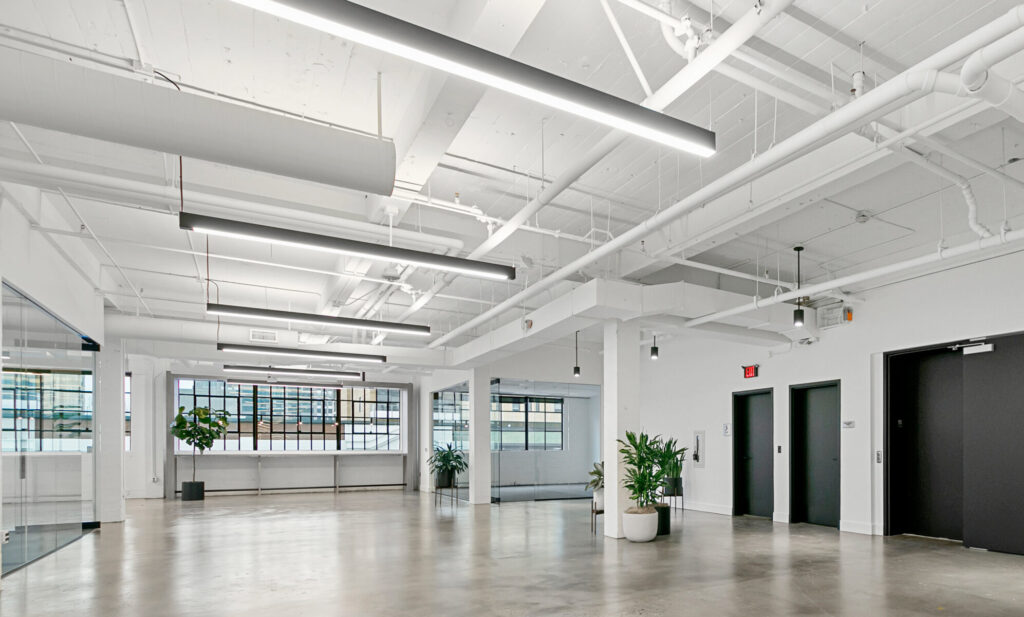
This is where properly designed blue-sky-boosted lighting has a compelling role. It provides a comfortable, natural-feeling spectrum that delivers adequate biologically effective daytime light toward the eyes while maintaining appropriate light at the task plane.

How much deep red light exposure is beneficial?
Sunlight contains abundant red and near-infrared (NIR) radiation, and researchers have spent decades studying whether these wavelengths can produce biological effects through photobiomodulation (PBM). Laboratory and clinical research suggests that appropriately dosed red and NIR light, 10-100 times typical light levels, can influence mitochondrial and cellular signaling, with potential applications ranging from wound healing and pain to neurological and other conditions (Glass 2021; Heiskanen et al. 2020).
There is even evidence that some PBM effects can persist beyond the actual light exposure. But PBM is typically a deliberate treatment: specific wavelengths, irradiance, exposure time, and dose are applied to a particular tissue or body area. Research has not established that people need continuous low-level NIR exposure throughout the day simply because they spend time under LED lighting.
In fact, the evidence for PBM remains highly dependent on the application and dose. A 2025 umbrella review covering 204 randomized trials found potentially beneficial effects for several health outcomes, but concluded that evidence certainty was generally low to moderate and that better standardized trials are needed (Son et al. 2025). In a focused human study of NIR exposure, participants received 850-nm light five days per week for four weeks, with the highest tested dose producing improvements in mood and drowsiness. But this was a controlled PBM intervention and not ordinary room illumination (Giménez et al. 2022).
So, do LEDs need infrared built in?
The biological relevance of constant low level NIR is an active area of research and there is currently no scientific consensus that indoor lighting should provide them. The more important question may be whether people need occasional “trigger” exposure to red/NIR light, rather than whether every ceiling fixture needs to emit it continuously. Given the state of the research, the appropriate wavelength, dose, frequency, tissue target, and long-term significance remain active areas of research. That is very different from saying that IR-free LEDs are harmful.
It also means we shouldn’t dismiss the question. Sunlight gives us a broad spectrum, including visible, red, and infrared wavelengths, and humans spend increasingly large portions of their lives indoors. Researchers are still working to understand which components of natural light are most important for health and how they should be delivered indoors (Heiskanen et al. 2020). The research and applications in healthy illumination are advancing as academic labs and pioneering circadian lighting companies like BIOS, pioneer naturalistic lighting. The need, measurement, and recommendations for extensive blue-sky light exposure are well established (Brown et al. 2022), while near IR implications on public health and consequent actionable recommendations may take longer to establish.
Should violet light be added to our general lighting?
Another emerging area of light research involves OPN5 (neuropsin) receptor that is sensitive to colors between violet light and ultraviolet A (UVA), but its physiological role in humans remains incompletely understood (Ma et al. 2025). Of particular interest is the role of OPN5 activation in myopia (nearsightedness) suppression in children and potential for therapeutic interventions (Gettinger et al. 2026; Singh & Martin 2026).
This raises an interesting question: should healthy indoor lighting include more violet or near-UV light to activate OPN5? At present, the evidence does not establish a recommended exposure level, duration, or daily dose that produces a defined health benefit in humans. Nor is there currently an established OPN5-based lighting specification for general indoor environments.
Adding these wavelengths to everyday lighting would therefore present a design challenge: manufacturers would need evidence of the intended benefit, a reliable way to specify the required exposure, and appropriate photobiological safety assessment, particularly for wavelengths near the UVA boundary. In addition, violet light carries more energy that can fade and damage many materials, so dosage must be carefully considered for the indoor environment as well as occupants.
OPN5 is a promising research area, but its discovery does not mean that violet or UV light should automatically be added to healthy lighting. Before making it a lighting requirement, we need to establish what exposure is beneficial, for whom, and at what dose.
The Practical Approach to Bringing Healthy Light Indoors
Standard lighting and window glass means we are exposed to indoor light that is considerably narrower than the daylight. The value of blue-sky-boosted LED lighting available today is not in simply reproducing sunlight wavelength-for-wavelength, but in delivering enough biologically-effective daytime light to the eyes, at the appropriate time, while maintaining visual comfort, energy efficiency, and good-quality illumination.
As for infrared and Violet/UVA? These are intriguing areas of science worth continuing to investigate. But based on today’s evidence, there is no reason to conclude that general LED lighting needs to accommodate that broad a spectrum. Although the standards for healthy lighting could evolve more over time, the now and near future of healthy lighting isn’t about adding all wavelengths to every fixture. It’s about providing a scientifically supported, cost-effective solution to give people the healthy light they need today.
References
Barrett EM, Jeffery G. LED lighting (350-650nm) undermines human visual performance unless supplemented by wider spectra (400-1500nm+) like daylight. Scientific Reports. 2026 Jan 23;16(1):3061. https://doi.org/10.1038/s41598-026-35389-6
Brown TM, Brainard GC, Cajochen C, Czeisler CA, Hanifin JP, Lockley SW, Lucas RJ, Münch M, O’Hagan JB, Peirson SN, Price LL. Recommendations for daytime, evening, and nighttime indoor light exposure to best support physiology, sleep, and wakefulness in healthy adults. PLoS biology. 2022 Mar 17;20(3):e3001571. https://doi.org/10.1371/journal.pbio.3001571
CIE (International Commission on Illumination). CIE Position Statement on Integrative Lighting—Recommending Proper Light at the Proper Time, 3rd Edition (CIE PS 001:2024). International Commission on Illumination.
Illuminating Engineering Society. ANSI/IES RP-46-25: Recommended Practice: Supporting the Physiological and Behavioral Effects of Lighting in Interior Daytime Environments. 2025. https://youtu.be/mOsX4asxho4
Gettinger K, Tsubota K, Negishi K, Kurihara T. Light and myopia: a focus on the expanding role of non-visual opsins. Eye and Vision. 2026 Jan 31;13(1):6. https://doi.org/10.1186/s40662-025-00472-y
Giménez MC, Luxwolda M, Van Stipriaan EG, Bollen PP, Hoekman RL, Koopmans MA, Arany PR, Krames MR, Berends AC, Hut RA, Gordijn MC. Effects of near-infrared light on well-being and health in human subjects with mild sleep-related complaints: a double-blind, randomized, placebo-controlled study. Biology. 2022 Dec 29;12(1):60.
https://doi.org/10.3390/biology12010060
Glass GE. Photobiomodulation: A review of the molecular evidence for low level light therapy. Journal of Plastic, Reconstructive & Aesthetic Surgery. 2021 May 1;74(5):1050-60. https://doi.org/10.1016/j.bjps.2020.12.059
Heiskanen V, Pfiffner M, Partonen T. Sunlight and health: shifting the focus from vitamin D3 to photobiomodulation by red and near-infrared light. Ageing research reviews. 2020 Aug 1;61:101089. https://doi.org/10.1016/j.arr.2020.101089
Ma J, Rahaman SM, Ohmura Y, Yamanaka A. The physiological functions of OPN5m. Eye and Vision. 2025 Dec 2;12(1):48. https://doi.org/10.1186/s40662-025-00467-9
Singh NK, Martin J. Role of light in eye growth and light as a therapy for myopia control. Frontiers in Ophthalmology. 2026 Aug 5;6:1812006.
https://doi.org/10.3389/fopht.2026.1812006
Shinhmar H, Hogg C, Neveu M, Jeffery G. Weeklong improved colour contrasts sensitivity after single 670 nm exposures associated with enhanced mitochondrial function. Scientific reports. 2021 Nov 24;11(1):22872. https://doi.org/10.1038/s41598-021-02311-1
Son Y, Lee H, Yu S, Kim HJ, Park J, Woo S, Lee H, Fond G, Boyer L, Rahmati M, Smith L. Effects of photobiomodulation on multiple health outcomes: an umbrella review of randomized clinical trials. Systematic Reviews. 2025 Aug 6;14(1):160.
https://link.springer.com/article/10.1186/s13643-025-02902-3