




Over the past decade, the scientific community has reached a strong consensus that blue sky wavelengths—particularly in the 480–490 nm range—play a critical role in regulating human biology. This portion of the spectrum helps set our circadian clock, while also supporting mood, focus, and alertness. Yet despite this knowledge, these wavelengths are largely missing from the indoor environments where we now spend the vast majority of our lives.
The World Built Efficient Buildings—But Left Biology Behind
Modern buildings have been optimized for energy efficiency, cost control, and visual comfort. Those are important achievements, but they’ve come with an unintended tradeoff. In prioritizing energy performance, we’ve largely eliminated the very light signals our bodies depend on to function properly.

Extensive clinical and field measurements across offices, schools, and healthcare environments consistently show that standard electric lighting is weak in blue sky content. Even spaces that appear bright often fail to deliver meaningful circadian stimulation. Windows and skylights help, but their effectiveness is limited by building depth, glazing, orientation, season, and time of day. For many occupants, especially those seated further from windows, the biological impact of daylight is minimal.
The result is a built environment that is visually adequate, but biologically insufficient.
The Blue Sky Effect
Humans evolved under open skies. Every day, bright blue-enriched light from above signaled our bodies to wake up, stay alert, and synchronize with the natural day–night cycle. This is what we refer to as the “Blue Sky Effect”—the physiological response to overhead, blue-rich daylight that drives alertness, mood, and performance.
Today, that signal is largely dampened indoors. People spend more than 90% of their time inside, under lighting that may look white, but does not behave like daylight biologically. This disconnect contributes to fatigue, reduced mood, focus, sleep quality, and diminished overall well-being.

What Our Bodies Actually Need
New lighting industry guidance such as the newly released recommended practices IES RP-46-25 reflects this growing understanding of light and health. Rather than focusing only on visual brightness, it emphasizes the importance of delivering sufficient melanopic light at the eye during the day, while minimizing it in the evening.
In practical terms, this means indoor environments must provide a strong, natural feeling blue-sky-like signal during the day—delivered at high angles, but without creating glare, discomfort or excess energy consumption. Achieving that balance with conventional lighting approaches, however, has proven difficult.
Limitations of Standard Electric Lighting
Most lighting systems in use today were designed for visual tasks, not human biology. Increasing brightness (and power usage) to compensate often leads to glare and occupant discomfort. Color tuning, while useful for aesthetics, does not reliably produce the biological signal associated with natural daylight. And typical ceiling lighting directs light downward, illuminating surfaces more effectively than it reaches the eye.
Even high color temperature (CCT) lighting that appears “cool” or “daylight-like” lacks the spectral and spatial characteristics needed to recreate the Blue Sky Effect.
In short, traditional approaches address how a space looks—but not how it makes people feel or perform.
Recreating Blue Sky Indoors
This challenge is what led to the founding of BIOS Lighting. Taking a science-first approach, we analyzed the spectrum of natural daylight, modeled its biological impact, and validated our findings through both simulations and real-world measurements. The conclusion was straightforward: seeing blue sky light—whether through architecture or electric lighting—is essential for human health and performance.
That insight led to the development of SkyView™ lighting system, a new category of general illumination designed to bring the experience of a blue sky day indoors.
It’s Like an Electric Skylight for Every Space
SkyView™ functions much like an electric skylight. It delivers blue-enriched light from above—where the circadian system is most responsive—while maintaining a natural, comfortable visual environment. Unlike conventional systems, it does not rely on excessive brightness or harsh color shifts to achieve its effect.
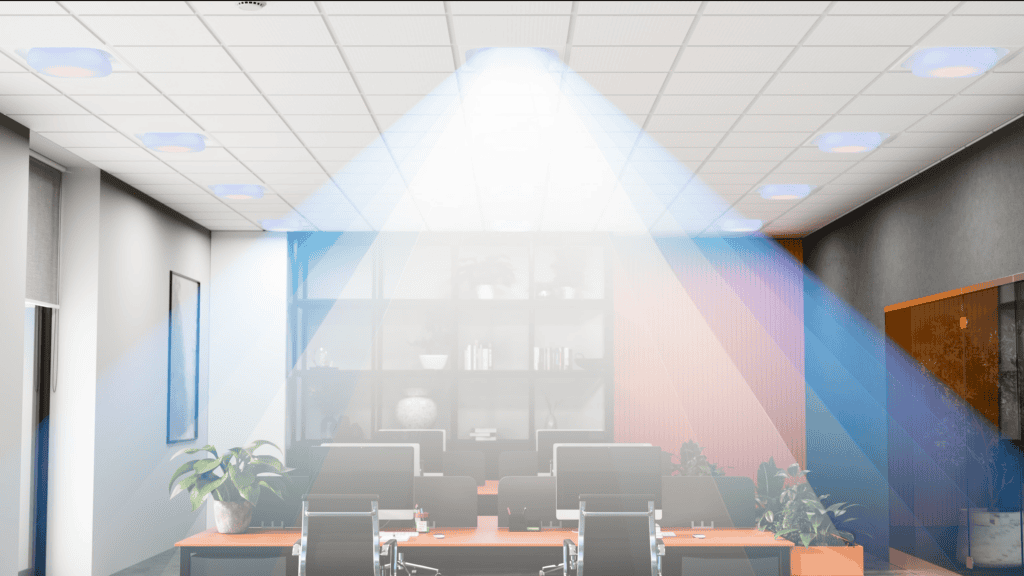
Instead, it recreates the qualities of daylight in a way that works within real buildings, budgets, and energy constraints. The result is a lighting environment that feels natural, supports alertness, and remains comfortable throughout the day.
The Measurable Impact of Blue Sky Light
What makes this approach particularly compelling is that its benefits are not just theoretical. Field and clinical studies have shown that environments designed to replicate blue sky light can significantly improve how people feel and perform—enhancing mood, increasing focus, and boosting alertness in ways that directly impact productivity and well-being.
These are the same benefits people experience naturally outdoors on a clear day, now made accessible indoors, regardless of geography or building design.
A New Way to Think About Light
Healthy blue sky lighting represents a shift in how we think about illumination. It moves beyond the idea that lighting is simply about visibility and toward a more complete understanding of its role in human health.
Instead of asking, “Is this space bright enough?” we should also be asking, “Is this space biologically effective?”
And given limitations in daylighting we should also be asking “how can I implement a cost-effective upgrade to achieve healthy lighting anywhere in my built environment.”
Bringing the Blue Sky Indoors
In a world where indoor living is the norm, reconnecting people with the benefits of natural light is no longer a luxury—it’s a necessity. By prioritizing blue sky light indoors, we can create spaces that support not only how we see, but how we feel, think, and perform.

SkyView™ is a patented, practical, high-melanopic lighting technology designed to meet new daytime and evening criteria without increasing glare or exceeding energy codes.
With the SkyView™ lighting solution, it becomes possible to bring the experience of a blue sky day into any environment—like adding a skylight everywhere in the building—helping people thrive, no matter where they are.